Friday, May 7, 2010

Oil Starts to Wash Up on Coast


Coastguards have confirmed that oil is washing up on the US shoreline for the first time after the BP rig disaster.

Teams tackling the crisis in the Gulf of Mexico reported the presence of oil on a beach of an outlying island off Louisiana.

Oiled birds including gannets and brown pelicans have been found on the Chandeleur Islands.

"We have teams that have confirmed oil on the beach, at the south end of the Chandeleur Islands, at Freemason Island," coastguard Connie Terrell said.

"This is the first confirmation that Unified Command has received of oil on a shoreline," she added.

"It's largely just sheen, there is no evidence of medium or heavy oil," Ms Terrell said.

BP spokesman John Curry said three emergency response teams had been sent to the island, 30 miles off the mainland.

Inflatable booms to try to protect the prime marsh and wildlife area were being deployed, Mr Curry said.

"We are doing everything we can to make sure a major impact doesn't happen," Mr Curry said.

The Chandeleur Islands form the easternmost point of Louisiana and are part of the Breton National Wildlife Refuge.

They are the second oldest refuge in the United States and home to countless endangered shorebirds.

Thursday, April 29, 2010

It Makes Me Smile....

what's the big deal?
Source
You're welcome.....

Mack (R) compares Ariz. law to Nazi Germany


Rep. Connie Mack (R-Fla.) ripped into the new Arizona immigration law today, comparing it to Nazi Germany.

"This law of 'frontier justice' – where law enforcement officials are required to stop anyone based on 'reasonable suspicion' that they may be in the country illegally – is reminiscent of a time during World War II when the Gestapo in Germany stopped people on the street and asked for their papers without probable cause," Mack said in a statement.

"This is not the America I grew up in and believe in, and it’s not the America I want my children to grow up in," he added.

The Arizona law would allow law enforcement officers who come into legal contact with individuals to demand proof of citizenship if there is a "reasonable suspicion" that person may be undocumented.

Considered a potential candidate for statewide office in Florida, Mack's position may help with the state's large Hispanic population.

Marco Rubio has also criticized the bill.

Texas Reps Want to Import AZ Immigration Law


A Republican Texas lawmaker plans to introduce a tough immigration measure similar to the new law in Arizona, a move state Democrats say would be a mistake.

Rep. Debbie Riddle of Tomball said she will push for the law in the January legislative session, according to Wednesday's editions of the San Antonio Express-News and Houston Chronicle.

"The first priority for any elected official is to make sure that the safety and security of Texans is well-established," said Riddle, who introduced a similar measure in 2009 that didn't get out of committee. "If our federal government did their job, then Arizona wouldn't have to take this action, and neither would Texas."

The Arizona law would require local and state law enforcement to question people about their immigration status -- and make it a crime for immigrants to lack registration documents.

The measure is already making an impact in North Texas. Organizers for a rally against the immigration law said Tuesday they hope for 100,000 protesters to show up for a Saturday march in Dallas. Leaders of various groups are planning to attend.

"What I say to the African-American community: If they come in the morning for brown-skinned people, and we remain silent, they may come in the evening for us," Peter Johnson, of the Peter Johnson Institute of Non-Violence, said.

"This wholesale idea of just questioning everyone who looks differently or who has an accent or whose eyes look differently than ours is not the way to address this issue," said Cheryl Pollman, president of the National Council of Jewish Women.

The Dallas Tea Party said it will plan a counterprotest for another time.

Phillip Dennis, a member of the group's steering committee, said states have to step up because the federal government has failed to enforce immigration laws. He said he and his wife, who is a legal immigrant from Colombia, are familiar with the process of emigrating to the United States.

"We paid by the rules, we jumped through the hoops, and we paid the money -- thousands and thousands of dollars," he said.

Homeland Security Secretary Janet Napolitano told a U.S. Senate hearing Tuesday that a Justice Department review is under way to determine the constitutionality of the Arizona law.

State Sen. Leticia Van de Putte, a San Antonio Democrat and former president of the National Hispanic Caucus of State Legislators, called the law "extremely damaging and hateful."

Van de Putte predicted failure for any similar measures in Texas and said the GOP would suffer politically for such a move.

Asked about the Arizona law, GOP Gov. Rick Perry and his Democratic challenger, Bill White, emphasized through spokespeople that immigration is a federal responsibility.

Jim Harrington, of the Texas Civil Rights Project, predicted any similar effort in Texas would fail because Texas has "a different relationship with the Hispanic community."

"You can take the political temperature by just looking at Rick Perry being quiet," Harrington said.

Tuesday, April 20, 2010

Patriots


ARLINGTON, Va. – Carrying loaded pistols and unloaded rifles, dozens of gun-rights activists got as close as they could Monday to the nation's capital while still bearing arms and delivered what they said was a simple message: Don't tread on me.

Hundreds of like-minded but unarmed counterparts carried out a separate rally in the nation's capital.

The gun-carrying protesters in Virginia rallied on national park land, which is legal thanks to a new law signed by President Barack Obama that allows guns in national parks. Organizers said it's the first armed rally in a national park since the law passed.

The District of Columbia's strict gun laws, however, generally make it illegal to carry a handgun, so rally participants there were unarmed.

Daniel Almond, who organized the "Restore the Constitution" rally in Virginia, said he wanted to convene in a place where "we can exercise our rights." He pointed in the direction of Washington and said, "Over there, the Constitution is being violated in that we cannot bear arms."

Among the speakers in Virginia was former Alabama Minuteman leader Mike Vanderboegh, who has been denounced in recent weeks after calling for citizens to throw bricks through the windows of local Democratic party headquarters across the country. Several such incidents occurred after Vanderboegh issued his call.

Vanderboegh said the broken windows are a wake-up call that many people feel threatened by an expanding federal government.

"We are done backing up. Not one more inch," Vanderboegh said to cheers, after telling the crowd that for too long Americans have acquiesced at the loss of liberty.

In an interview, Vanderboegh said he considers armed resistance justified only "when they send people to our doors and kill us."

But he suggested that an arrest at the hand of federal government is tantamount to a death sentence and that he would fight back in such a case. Specifically, he outlined a scenario in which people who refuse to buy health insurance under the new health reform law would be subject to arrest and that such confrontations could turn violent.

"If I know I'm not going to get a fair trial in federal court ... I at least have the right to an unfair gunfight," Vanderboegh said.

After his speech, gun control advocate Martina Leinz confronted Vanderboegh and called him a "small, little bully" and said the rally was designed to intimidate.

"If they wanted to have dialogue, they don't need to bring a big weapon with them," she said of the protesters.

The rally began in Fort Hunt Park and moved to Gravelly Point in Arlington, next to Reagan National Airport and just south of the nation's capital, with the Washington Monument and the U.S. Capitol in the backdrop. Departing planes frequently drowned out speakers, and reporters nearly outnumbered rally participants.

Ken Garvin of Newville, Pa., said he had never before attended such a rally but came Monday because he believes the government is out of control. He stressed that the people attending the rally "are not a bunch of crazed thugs. ... They're just people." He said all sides need to listen to each other's viewpoints.

"I don't hate the left. I just don't understand where they're coming from," he said.

Wes Wdzieczny of Essex, Md., said people are unduly alarmed if they see rallies like these as promoting violence.

"I don't think anyone here has delusions of storming the Capitol. ... People are just basically fed up," he said.

In Washington, signs reading "Which part of 'shall not be infringed' confuses you?" and bright orange stickers saying "Guns save lives" dotted the crowd at the Washington Monument.

Organizer Skip Coryell said he chose the date to mark the anniversary of the Revolutionary War battles of Lexington and Concord, and dismissed any associations with the actions of Oklahoma City bomber Timothy McVeigh. The bombing occurred on April 19, 1995.

"I think there are some people out there who have an agenda and they want to paint us as gun-toting, lunatic, militia types, and we're not that way," Coryell said.

The event also attracted 78-year-old Audrey Smith of Clearfield, Pa., who said she and a group of local Tea Party activists traveled to show their solidarity.

"We'll support anything that is in jeopardy of being taken out of our Constitution," Smith said.

U.S. Rep. Jim Moran, D-Va., said in a statement that armed protests in national parks were a public safety concern. He also said that while the Second Amendment has become a rallying point for gun rights activists, "virtually every action the federal government has taken in the past decade has weakened commonsense gun laws already on the books."

56,000 Photos Taken By Student "Spy" Cams


Lower Merion School District employees activated the web cameras and tracking software on laptops they gave to high school students about 80 times in the past two school years, snapping nearly 56,000 images that included photos of students, pictures inside their homes and copies of the programs or files running on their screens, district investigators have concluded.

In most of the cases, technicians turned on the system after a student or staffer reported a laptop missing and turned it off when the machine was found, the investigators determined.

But in at least five instances, school employees let the Web cams keep clicking for days or weeks after students found their missing laptops, according to the review. Those computers - programmed to snap a photo and capture a screen shot every 15 minutes when the machine was on - fired nearly 13,000 images back to the school district servers.

The data, given to The Inquirer on Monday by a school district lawyer, represents the most detailed account yet of how and when Lower Merion used the remote tracking system, a practice that has sparked a civil rights lawsuit, an FBI investigation and new federal legislation.

The district's attorney, Henry Hockeimer, declined to describe in detail any of the recovered Web cam photos, or identify the people in them or their surroundings. He said none appeared to show "salacious or inappropriate" images but said that in no way justified the use of the program.

"The taking of these pictures without student consent in their homes was obviously wrong," Hockeimer said.

A federal magistrate judge is expected this week to begin the process of arranging for parents whose children were photographed to privately view the photos.

Hockeimer said the district's internal investigation is ongoing and that the numbers could change. He said the board authorized him to release the information in response to a new court motion filed last week by Harriton High School sophomore Blake Robbins, whose lawsuit contends the program invaded his privacy.

In the motion, Robbins' attorney, Mark Haltzman, argued that the now-disabled system had surreptitiously collected more than 400 photos of his client - including shots of him when he was shirtless and while he slept in his bed last fall - as well as thousands of images from other students' computers.

The numbers disclosed by the district Monday confirmed that assertion and added more clarity. The district's full report is due within the next two weeks.

Lower Merion began using the system after deciding to give each of its nearly 2,300 high school students their own laptop computer. The program started in 2008 at Harriton High School and expanded this school year to Lower Merion High.

In addition to the photos and screen shots, the technology also used the laptop's Internet address to pinpoint its location. The system was designed to automatically purge all the images after the tracking was deactivated.

Hockeimer said that attorneys from his firm, Ballard Spahr, and specialists from L3, a computer forensics firm, have used e-mails, voice mails and network data to piece together how often, when and why school officials used the technology.

The "vast majority" of instances, he said, represent cases in which the technology appeared to be used for the reasons the district first implemented it in 2008: to find a lost or stolen laptop or, in a few cases, whether a student took the computer without paying a required insurance fee.

About 38,500 images - or almost two-thirds of the total number retrieved so far - came from six laptops that were reported missing from the Harriton High School gymnasium in September 2008. The tracking system continued to store images from those computers for nearly six months, until police recovered them and charged a suspect with theft in March 2009.

The next biggest chunk of images stem from the five or so laptops where employees failed or forgot to turn off the tracking software even after the student recovered the computer.

In a few other cases, Hockeimer said, the team has been unable to recover images or photos stored by the tracking system.

And in about 15 activations, investigators have been unable to identify exactly why a student's laptop was being monitored.

Hockeimer said that the investigation found that administrators activated the tracking system for just one student this year who failed to pay the $55 insurance fee.

Robbins claims he is that student; Hockeimer declined to confirm or deny that.

About 10 employees at the district and its two high schools had the authority to request the computer administrators to activate the tracking system on a student's laptop, Hockeimer said.

Only two employees - information systems coordinator Carol Cafiero and network technician Mike Perbix - have the ability to actually turn on and off the tracking. Hockeimer said the district investigators have no evidence to suggest either Perbix or Cafiero activated the system without being asked.

But the requests were loose and disorganized, he said, sometimes amounting to just an brief e-mail.

"The whole situation was riddled with the problem of not having any written policies and procedures in place," Hockeimer said. "And that impacted so much of what happened here."

Robbins has claimed that an assistant principal confronted him in November with a Web cam photo of him in his bedroom. Robbins said the photo shows him with a handful of Mike & Ike candies, but that the assistant principal thought they were drugs.

His attorney, Haltzman, greeted the release of the numbers skeptically.

"I wish the school district would have come clean earlier, as soon as they had this information and not waiting until something was filed in court revealing the extent of the spying," he said.

New Immigration Law in Arizona


Lawmakers in the Arizona Senate voted 17 to 11 to approve the bill, widely regarded as the toughest measure yet taken by any U.S. state to curb illegal immigration.

The state's House of Representatives approved the measure last week. Governor Jan Brewer, a Republican, has five days to veto the bill or sign it into law.

Immigration is a bitterly fought issue in the United States, where some 10.8 million illegal immigrants live and work in the shadows, although it has been eclipsed in recent months by a healthcare overhaul and concern over the economy.

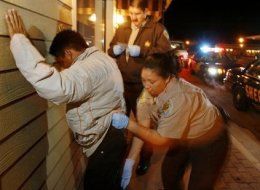
The law requires state and local police to determine the status of people if there is "reasonable suspicion" that they are illegal immigrants and to arrest people who are unable to provide documentation proving they are in the country legally.

It also makes it a crime to transport someone who is an illegal immigrant and to hire day laborers off the street.

"I believe handcuffs are a wonderful tool when they're on the right people," said Russell Pearce, the Republican state senator who wrote the bill.

We want to "get them off law enforcement and get them on the bad guys," he told Reuters.

Opponents of the Arizona law, some of whom held a vigil outside Brewer's home on Monday to urge her to veto the measure, say it is unconstitutional and would discriminate against Latinos.

"You cannot tell if a person walking on a sidewalk is undocumented or not ... (so) this is a mandate for racial profiling," said Pablo Alvarado, director of the National Day Laborer Organizing Network.

Alvarado said his group would call on the federal government to intervene and was considering legal action to overturn the bill.