Wednesday, November 10, 2010

***ATTENTION***


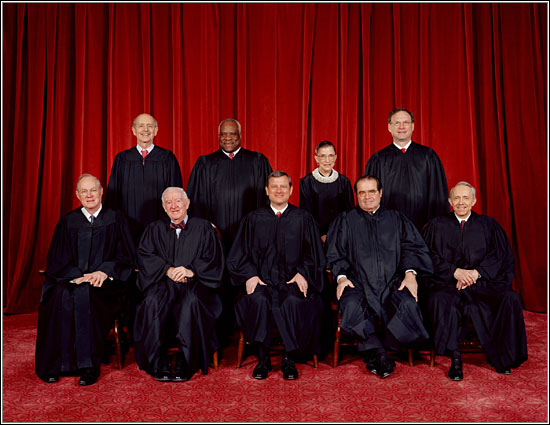
Friday afternoon at 5:00 p.m. at the Lubbock Civic Center, two Supreme Court Justices, Scalia and Breyer, will be debating. This is a truly once in a lifetime type experience. I have limited tickets to this event.
The event is FREE but you must have a ticket to get in.
If you are interested, I will take the first ones to let me know via this site.
I will let you know FRIDAY morning if you made the cut due to limited tickets.
I WILL COUNT YOUR ATTENDANCE AS AN EXTRA 100 IN YOUR QUIZ CATEGORY!!!

http://lubbockonline.com/local-news/2010-11-07/tech-law-host-supreme-court-justices-scalia-breyer

Thanks!

Thursday, November 4, 2010

House GOP May Investigate Obama


Rep. Darrell Issa (R-Calif.) pledged on Wednesday to investigate both Barack Obama and George W. Bush with his newfound subpoena power when he takes over as chairman of the House Oversight and Government Reform Committee.

“I’m going to be investigating a president of my own party, because many of the issues we’re working on began [with] President Bush or even before, and haven’t been solved,” Issa said during an interview on MSNBC’s “The Daily Rundown.

Issa made clear that he intends to examine both the Bush and Obama administrations’ handling of the mortgage crisis, as well as problems at the old Mineral Management Service, an arm of the Interior Department reorganized amid reports of corruption.

“When we look at the failures of Freddie [Mac] and Fannie [Mae], the Countrywide scandal, those all began during President Bush’s time,” Issa said. “When we look at Mineral Management Service and the ultimate failure in the Gulf, that began years before.”

“I’m hoping to bridge the multiple administrations in as many places as possible,” Issa pledged. “The enemy is the bureaucracy, not necessarily the current occupant of the White House.”


Wednesday, November 3, 2010

Welcome to Gridlock


This election was not about the traditional wedge issues that usually plague politics: abortion, religion, and gay marriage. Instead, this election was about economic ideology.

On the one side were the Democrats, with the general belief that you need to invest in programs to restore economic strength. On the other side were the Republicans. And then there was the Tea Party, which has seemed to coalesce around the idea of spending as little as possible.

The problem is, of course, that economic modeling can’t be effectively reduced to 140-character sound bites. The other problem is that economics itself is a completely inexact science, and so the theories are just that: theories.

Even so, most Americans have a pretty good gut feel for what makes them nauseous. Trillion dollar deficits, changes to their health care that they can’t predict, and a continuing bad feeling about the future make us all feel slightly queasy.

The result: a major loss for the Democrats in the House, a moderate loss in the Senate, and surprising gains for Tea Party candidates.

Loss of faith

Key to this election defeat was a loss of faith in President Obama’s policies. His promises during the 2008 election cycle seemed to result in payoffs to big banks and insurance companies, but no real feeling of change to Joe the Baker.

So even though many of Obama’s policies actually accomplished good, including probably fending off another Great Depression and pretty much turning around what was a constant, terrifying job drain, his policies didn’t seem to accomplish good enough. The resulting nearly universal feeling of malaise was enough to provide a strong drubbing to the Dems.

So here we are. In 2011, the House will be run by Democrats, the Senate by Republicans, and the White House by President Obama.

Is the new gridlock the same as the old gridlock?

Normally, with a mixed body governing, you’d immediately assume a new level of gridlock in Washington. But there’s nothing new here. Even with the Democrats’ initial “super-majority” back in 2009, they were unable to move their agenda and so we’ve effectively had gridlock since Mr. Obama assumed office.

The interesting question is how things will change now that Speaker Boehner will be in charge?

Without a doubt, the Republican/Tea Party-held House will field some truly nutball bills, pandering to the extremists in their parties. These bills will create a lot of fuss, but will die in the Senate (if they even get there) and will have no real effect.

The big question is whether the GOP fields any reasonably constructive bills that will help America. If they do, we may actually have less gridlock with a divided Congress than we did before. That’s because Harry Reid has a long record of giving into GOP bullying, and so, if the GOP can field anything even remotely sane, they’re likely to be able to cajole Reid into going along.

It’ll be interesting to see if the Republicans can balance their ideological extremes and actually do any good in Washington.

One final note. Both Carly Fiorina and Meg Whitman lost their bids. Although I didn’t agree with them on policy issues, I was disappointed to see two strong tech candidates go down to defeat. I still hope that sometime in the future, we’ll get some very strong, tech-aware candidates into positions of policy power in the United States.

Oh, well. There’s always 2012.

Tuesday, November 2, 2010

Perry's Prediction


Senate

Republican's must pick up 10 seats in the Senate for a majority.

GOP +8

Races to watch:
Wisconsin and (D) Russ Feingold. Co-author of campaign finance reform bill with Republican John McCain. His moderation is now a weakness. I see him losing.

Nevada (D) Harry Reid. Senate Majority is in the race of his career. Current polls show his opponent ahead. It may be a late night out west.

House of Representatives

Republican's must pick up 39 seats in HoR for a majority

GOP +55

Governor

GOP +9
Including Texas

Obama's Next Worry May Be From His Left


Voter discontent this year isn't confined to the tea party. A new AP poll reports that 51% of Americans now think President Obama doesn't deserve re-election. More surprising, 47% of Democrats believe he should face a challenge for the party's nomination in 2012. No doubt many Democrats who hold this view are disappointed supporters of Hillary Clinton.

In reality, Mr. Obama doesn't have to worry too much about renomination. There are no signs that Mrs. Clinton would resign as secretary of state and challenge her boss. African-Americans, the president's strongest group of supporters, make up 30% of any Democratic primary electorate and provide him with a firewall against any opponent. And presidents from Ronald Reagan to Bill Clinton have rebounded after midterm defeats as the economy improved.

Still, a primary challenge, even if waged by a less-significant contestant, is a serious matter. Every president who lost re-election in the last half century has first been weakened by a primary fight—Gerald Ford, Jimmy Carter and George H.W. Bush being cases in point. Many of the three million voters Pat Buchanan attracted in 1992 against Mr. Bush, for example, wound up voting for Ross Perot in November. This allowed Bill Clinton to win with just 43% of the popular vote.

Today, party discontent with the president is real. Last week, leading Democrats were furious when Mr. Obama declined to endorse Rhode Island's Democratic gubernatorial candidate, Frank Caprio. This was payback for Lincoln Chafee's support of Mr. Obama's candidacy in 2008—Mr. Chafee is running for governor as an independent. "The notion that the leader of the party is being disloyal to his party is I think unprecedented," Democratic strategist Paul Begala told CNN.

Key donors have told the White House that the president should decide for certain whether he's running for re-election by the end of December. Should Mr. Obama's approval ratings slip further next year, there's talk that some donors may call on him not to run, or promote an independent candidacy by New York Mayor Michael Bloomberg.

It could go further. Pennsylvania Gov. Ed Rendell, a former chairman of the Democratic National Committee, told MSNBC in July that a primary challenge to Mr. Obama "is really possible," especially if he were to go back on his pledge to begin withdrawing U.S. troops from Afghanistan next year.

A disgruntled peace candidate such as former Vermont Gov. Howard Dean, Wisconsin Sen. Russ Feingold or Ohio Congressman Dennis Kucinich could find the prospect of rallying disgruntled leftists too tempting to resist. All three men forswear any interest in challenging Mr. Obama, yet it's noteworthy that Mr. Dean is stepping up his speaking schedule around the country after the election.

Mr. Dean blames Republicans for blindly opposing the president but says Democrats have some responsibility for voter anger. "There was a misunderstanding of the kind of change people wanted," he told the AP last month. "Democrats wanted policy change. Independents and Republicans wanted to change the way business was done in Washington, and that really hasn't happened."

In the aftermath of a disappointing 2010 midterm election, some liberals may follow the path of the tea party. Tom Streeter, the co-author of "Net Effect," a book on the lessons of Mr. Dean's Internet-driven 2004 presidential campaign, says tea party supporters "share with the Deaniacs a sense of being ignored by the powers that be, and an enthusiasm and energy in the feeling that they are striking back."

Progressives are still rankled by White House Press Secretary Robert Gibbs's attack in August on "the professional left" for not supporting Mr. Obama sufficiently. David Sirota, a prominent blogger, says that liberals feel "one hundred percent" taken for granted by the White House.

Most liberals I spoke to don't support a primary challenge. Jane Hamsher, founder of Firedoglake.com, a leading liberal blog, is less categorical. She blames Mr. Obama for "appropriating the progressive message, and then not governing as one." She has always backed "a diversity of voices in the primary process as a sign of a healthy democracy."

Obama's Waterloo?


What a difference two years can make. It’s hard to believe, but in November 2008, America – or at least a sizeable chunk of it – tottered punch-drunk with love for President Barack Obama. After eight years of George W. Bush’s staccato speeches, the nation, and its left-wing press in particular, lauded Mr. Obama’s every melodious word. Meanwhile, Republicans despaired of being swept aside, possibly for several election cycles, by a tsunami of desire for hope and change.

Fast-forward to November 2010. America seems like a different planet, and Mr. Obama a different man. He has downgraded his famous slogan, “Yes we can”, to a tired-sounding “Yes we can but…” Where he once roared, he now whines. It’s the Republicans’ fault for leaving him a mess; it’s the voters’ fault for not understanding what he’s trying to do. In an attempt to shore up his plummeting popularity, he gravitates to “trendy” media, from Rolling Stone magazine to the Daily Show, paradoxically diminishing the gravitas of his leadership – and the American presidency itself – with every interview.

Meanwhile, the Tea Party Express thunders across the land, selling a different brand of change. Fueled by anger instead of hope, its campaign has galvanized not only those who didn’t vote for Mr. Obama, but those who have become disillusioned, even terrified, by what he has done to the country. The President’s big-government legislation on stimulus spending and health care convinced many Americans he is bent on turning their nation into a socialist state. His anaemic response to the Gulf Oil Spill and foreign policy challenges have others worried that he is simply not up to the job of Leader of the Free World, at home or abroad.

Mr. Obama complains about having inherited a mess from Mr. Bush. The truth is, without a mess, Mr. Obama would never have been elected. His personal story and silver tongue appealed to voters who were tired of his predecessor’s simplistic statements, ballooning deficits and war without end. As fellow presidential aspirant Hillary Clinton bitterly learned, timing is everything in politics – and Mr. Obama’s moment had come.

But timing is both friend and foe. The new President’s ambitious agenda, designed to tackle “mess number one”, ran smack into the titanic problems of “mess number two”. In 2007, the credit crisis began to devastate the American housing market, throttle its lending market, and send unemployment numbers through the roof. Once elected, Mr. Obama, a believer in state intervention, predictably turned to government – and taxpayer dollars – to try and solve the problem. The result? Today 9.6% of Americans are still unemployed and the country is facing trillion-dollar deficits for most of the next decade.

Mr. Obama is looking more and more like President Jimmy Carter, a comparison that some pundits were making even before he took office. In 1976 Mr. Carter also rose from obscurity to prominence, promising to be “A leader, for a change.” Elected in reaction to the corruption of President Richard Nixon’s administration, and propelled by a swooning press, he took office at a time of high inflation and unemployment. But the new leader failed to deliver on his message of hope. Instead, the American economy spiralled into stagflation and Mr. Carter’s agenda was overwhelmed by the Iran Hostage Crisis.

The immediate legacy of Mr. Carter’s presidency was the election of Ronald Reagan in 1980. The long-term effect, however, was the revival of the conservative movement. The Republicans are clearly hoping that the 2012 Presidential election will play out the same way – but to seize the opportunity, they first have to find the right candidate.

There is certainly no shortage of aspirants. Former Massachusetts Governor Mitt Romney, who ran for the 2008 Republican nomination, is criss-crossing America – flying coach, no less – to boost his party’s chances in the midterms and test the waters for a Presidential bid. Sarah Palin, former Alaska governor and 2008 Vice-Presidential candidate, has become the Tea Party’s unofficial leader and a multi-media superstar. Even the wild cards are starting to play: financier and reality TV host Donald Trump is musing about running because, “Somebody has to do something. We are losing this country.”

Time will tell if the Republicans find their next Ronald Reagan – and two years is an eternity in politics. One thing is certain: the American people are already channelling their desire for change into new vessels. Tomorrow, the Republicans will reclaim control of the House of Representatives. Whether a one-term president or not, Mr. Obama’s agenda has already been curbed by the same winds which swept him to power: timing, circumstance, and the desire for change.

Historic Vote Possible


Voters this week look set to do something not seen since the early 1950s: Oust a substantial number of sitting House lawmakers for the third election in a row.

The apparent Republican resurgence suggests the country is caught in a cycle of political volatility witnessed only four times in the past century, almost all during war or economic unease.

The see-saw nature of the nation's politics raises a question: How can the country solve its long-term problems—deficit spending, an underfunded Social Security system, spiraling health-care costs—when voters seem so uncertain which party should lead the charge?

This fall's election has generated dozens of House races, from the suburbs of Denver and Chicago, across the South, and up the Ohio River Valley into New England, where voters who rejected Republicans in the past two elections are threatening to throw their support back to the GOP. In many cases, they're returning to the same candidates they rejected earlier.

The phenomenon is on full view in Indiana, where Democrats are fighting to keep three House seats they won in 2006. Voters in all three districts have a history, going back more than a century in some cases, of rejecting incumbents in moments of strain.

"We know what we don't want better than we know what we want," said Steve Ellison, a commercial real-estate broker who hosted a campaign event in his Mishawaka home for Republican challenger Jackie Walorski, who is trying to unseat two-term Democrat Joe Donnelly in the state's Second District. "I suppose that helps explain the schizophrenia."

If Republicans win big on Tuesday, as polls suggest, it is far from clear how firm a foothold they will have. Voters hold unfavorable views of both parties. Republican leaders acknowledge they could easily be tossed in 2012, just as they were in 2006.

The country has seen similar gyrations before. Financial panic in 1893 set the stage for a series of sharp swings in the 1890s. Republicans won a landslide in 1894, picking up 135 seats, but then lost 48 seats two years later, despite Republican William McKinley's triumph in the presidential race.

Then, in 1910, labor unrest and divisions within the GOP cost the party 57 House seats that year and 28 in 1912. World War I and its aftermath created a period of almost continual seesawing, with only one election (1916) seeing fewer than 20 House seats changing hands.

A realignment similar to 1894, but to the left, came in 1932 when voters wracked by the Great Depression elected Franklin D. Roosevelt as president and tossed out 101 Republicans from the House and nine from the Senate. That election, the third in a series of big swings in party support that began in 1928, marked the start of a Democratic dominance of Congress that lasted for decades with few interruptions.

But until now there has been only one other prolonged stretch—from 1946 to 1952—in which either party lost more than 20 seats. A wave of post-war strikes and President Harry Truman's low approval ratings helped Republicans gain 55 seats in 1946, and their first House majority since 1928.

Two years later, voters reacted to a "do-nothing Congress" by tossing out 75 Republicans. The GOP regained the House in 1952, but lost control in the next election. That drought would hold until Republicans roared back in 1994.

Some involved in politics today wonder if the current volatility will become part of the country's political fabric. Changes in the U.S. electoral map, with Republicans increasingly controlling the South and the Democrats dominant on the coasts and the industrial Midwest, plus changes in the makeup of the two parties, have deepened the country's political divide over the past 40 years, they say.

"You used to have clear liberal and conservative wings within each party, but that is less and less the case," said Tom Davis, a former congressman from Virginia who ran the National Republican Campaign Committee from 1998 to 2002. "Now, the parties are sharply drawn along ideological lines."

The result is a larger and more restive bloc of unattached voters, razor-thin margins in presidential votes, and frequent upheavals in control of Congress.

Amid all this, polls show voters themselves appear uncertain over what they want from elected officials. A Zogby International poll of more than 1,000 likely independent voters last month found that more than 70% wanted candidates who are "flexible" and "not afraid to be independent of their party."

But another survey, by the Allegheny College Center for Political Participation, found more than half of all registered voters wanted elected officials to shun compromise and stand firm on principle. Among likely Republican voters, those favoring no concessions topped 70%.

Analysts who dissect voting trends say the swings of partisan support being seen now, particularly among independent voters, is evidence more of serial disappointment than of chronic indecisiveness.

"You don't see voters changing their minds so much as independent and moderate voters looking for the same thing and never getting it," said William Galston, a former adviser to President Bill Clinton who studies governance issues at the Brookings Institution. "So you have a series of negative elections and rejections of the status quo."

The urge to reject those in power can be found this year in some unusual places. In Indiana's Second District, Mr. Donnelly, the two-term Democratic congressman, announced his re-election bid in the United Auto Workers union hall here in the car-factory town of Kokomo.

And for good reason: Measures passed by President Barack Obama and the Democrats in Congress clearly saved Kokomo from bigger trouble last year. The auto bailout kept the local Chrysler, General Motors and Delphi car-parts factories afloat. The plants employ more than 6,000 people in a city of just 48,000 inhabitants.

From his third-story office downtown, Mayor Greg Goodnight can point to some of the fruits of the more than $100 million in federal stimulus money the city and surrounding county have received over the past 18 months. Kokomo has newly reconfigured sidewalks, fresh rows of streetlights, repaved streets, a new bus system.

"But does Obama get the credit?" asked Mr. Goodnight, a Democrat who previously served as the head of the local steel union. "No, he doesn't. People want to blame someone, and he's the president. We all want immediate results."

Mr. Donnelly, in turn, is locked in a tight race against a challenger who says the auto bailout, the bank rescue and the Democrats' stimulus package were government boondoggles that have simply driven the country deeper into debt.

At Jamie's Soda Fountain a few blocks from City Hall, eight of the city's leading figures come together over mugs of coffee to debate politics and the latest news.

Mike Stegall, president of Community First Bank, gives Mr. Obama high marks for helping rescue the banks and the car companies last year. But he dings the president for the health-care overhaul and this summer's rewrite of the country's financial regulations. "He's selling an agenda no one really gets," Mr. Stegall said.

Local UAW president Richie Boruff jumps in. "Without Obama, Kokomo would be dead, including your community bank," he said.

Scott Pitcher, a local developer and the table's lone independent, says he voted for Mr. Bush in 2004 and for Mr. Obama four years later. But he isn't pleased by what has followed. "I am disappointed that there is so little confidence in the market, and I blame Obama for that," he said.

The debate, like the country, gets more volatile. Voices are raised. Mr. Stegall talks of a spreading "paranoia and fear." County Attorney Lawrence Murrell, joining the group late, speaks of impending socialism and says, "We are in a fight for our nation's soul." The comment draws a protest from Mr. Boruff.

Going around the table, in a town where the unemployment rate last year shot above 20% but has since dipped below 12%, four men in the group give the president a grade of D. Two give him an A. Mr. Obama comes out with an average grade of C-minus.